You awaken from a deep sleep that feels like death, and find yourself sealed inside a plastic bag. As you try to claw your way out, a robotic arm reaches down and pulls a tube from your throat. You have no idea where you are, or even who you are. You look around. Everyone else is dead, and you realize you are alone on a spaceship, very far from Earth. Sounds like the beginning of a horror movie, doesn’t it? And yet, the musical score by Daniel Pemberton is curious, evocative…even whimsical, leaving you feeling no horror at all as the protagonist tries to understand his very strange situation.
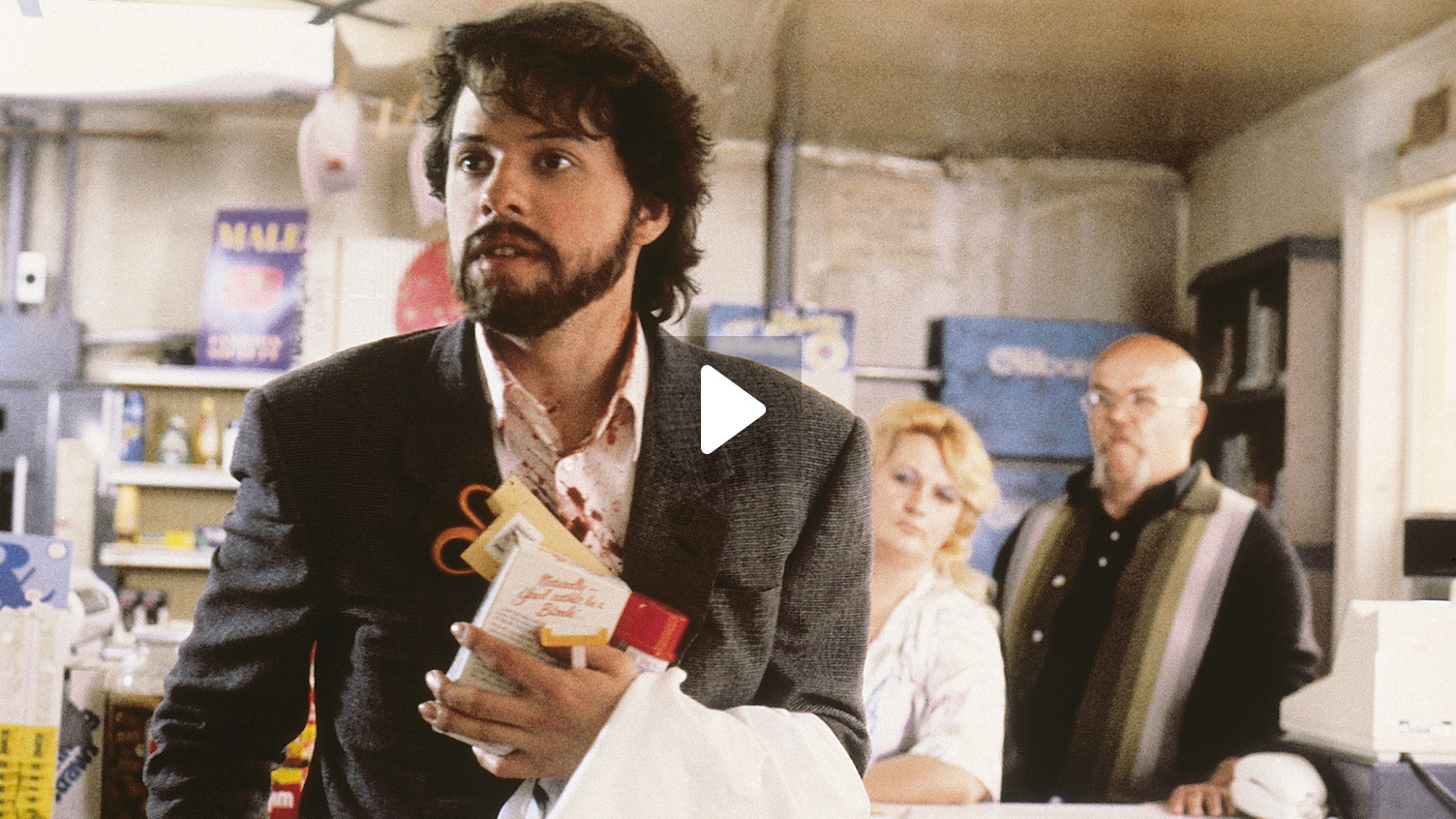
Welcome to Project Hail Mary, a 2026 film adaptation of Andy Weir’s novel of the same name. The film stars Ryan Gosling as Dr. Ryland Grace, a disgraced biologist now working as a middle school science teacher, similar to David Duchovny’s character Ira Kane in the 2001 Ivan Reitman film Evolution (except that Kane was teaching science at a community college). Project Hail Mary shares more common DNA with Evolution than it does with The Martian, the 2015 film adaptation by Ridley Scott of another of Andy Weir’s novels. In The Martian, a lone astronaut becomes stranded on Mars, and must “science the shit out of it” to survive until he might be rescued. It’s Cast Away (2000) in space. In both Project Hail Mary and Evolution, a dangerous alien is threatening all life on Earth, and apparently only a disgraced scientist-turned-teacher and his wacky sidekick can save the world.
Like The Martian, the timeline is never presented in Project Hail Mary. It’s the pretty near future, as most of the tech, fashion, language is identical to our own. The Sun has dimmed slightly, and it turns out its because some interstellar microbes are feeding on it. If they are not stopped, half the world’s population will die in the next few decades, with all life going extinct not long after. Every nearby star seems to be affected, with the singular exception of Tau Ceti. The science team decide to send a ship to Tau Ceti to investigate. They figure out how to harness the alien microbes as fuel to power the ship to near light speed.
Like the movie itself, let’s skip over any discussion of Relativity and travel at near-light speeds, and just accept that that’s the way this mop flops. Within the Tau Ceti solar system, Grace, all alone on the Hail Mary, encounters a second spaceship, where he befriends an alien rock organism he creatively names “Rocky”. Rocky, we learn, comes from the Eridani star system, and has come to Tau Ceti for the same reason as Grace – to learn why this particular sun remains unaffected by the alien microbe.
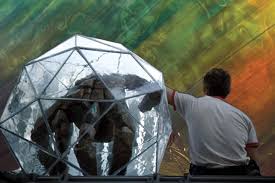
Rocky is an interesting imagining of alien life. He is composed entirely of a rock-like substance and apparently adapted to conditions without light. He has no face and sees by echolocation. Trust me, you’ve never seen a faceless rockpile and thought it was cute before. At least, not in a movie, you haven’t. Together, Rocky and Grace must figure out the mystery of Tau Ceti and save both their worlds.
Both Ryan Gosling and Sandra Huller (as Eva Stratt, who runs Project Hail Mary) carry the film with exceptional performances. James Ortiz provides the voice and puppetry for Rocky the Eridian. The film was directed by the creative team of Phil Lord and Christopher Miller, who previously gave us Cloudy With A Chance of Meatballs (2009) and Spider Man: Into the Spider-Verse (2018). It shouldn’t be a surprise at all that the team that came up with “spray-on shoes” also created this soft-sci-fi masterpiece.
I haven’t read any of Andy Weir’s books yet, so I’m unfamiliar with the writer’s intentional tonality in his works. Ridley Scott adapted The Martian as hard science fiction that feels lonely and desperate. Lord and Miller have created something soft, beautiful and almost poetic. Two worlds, two thriving civilizations, hang in the balance. Our two heroes are in constant danger, and yet there is never any doubt everything will be okay. Somehow, the mood of the film is such that we can watch but we never need to worry. We know Grace and Rocky will succeed, even though their task is nearly impossible. In their most dire moments, the music calms us, reassures us that everything will be alright. It’s the charisma of the actors (and puppeteers), the beauty of the cinematography, and the security of the soundtrack that keep us engaged right to the final frame.
Overall, Project Hail Mary is a wonderful experience of filmmaking that is a pleasure to watch, even repeatedly.