I love discovering a movie I’d never heard of before. I love when favorite actors sink their teeth into flawed, fucked-up characters. Paper Man (2009) satisfies on both levels.
An independent film initially created for the Sundance Film project, Paper Man is the brainchild of writer/director team Kieran and Michele Mulroney. Kieran is the brother of 90’s beau-hunk Dermot Mulroney (Young Guns, My Best Friend’s Wedding), and he is also primarily an actor. I remember him from the Star Trek: The Next Generation episode “The Outrageous Okona”. The film received a very limited theatrical release in 2010, and a limited UK DVD release the following year. Critics at the time, for the most part, hated it.
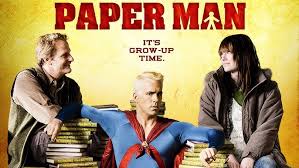
The protagonist is a failed writer named Richard (played by Jeff Daniels), whose wife (played by Lisa Kudrow), dumps him in a Long Island beach town to get over his writer’s block. There he meets and befriends a 17-year-old girl, and they both try to work through their shit together.
I love Jeff Daniels. He has this great way of leaning into the flaws of any character he plays, and he’s at his best when directors let him do it. Each personality flaw in his character is like a side dish at Thanksgiving, and Daniels is the perfect chef: he masterfully blends the differing elements into a wonderful overall experience of a human being, and taking any one element away from him would negatively impact the overall experience.
Richard has already written and published a novel. He hates it, and no one bought it. Now, he’s trying to write a second. He’s stuck on the opening sentence, a la Billy Crystal’s character in Throw Momma From The Train (1987). He is miserable in isolation while pretending it’s exactly what he wants. He feels a desperate need to contribute something to society, but, as he says over and over, he doesn’t know what to do with his hands. He never learned to cook and seems genuinely childlike in his inability to conquer adult things. The multi-colored couch with mismatched throw pillows acts like poison ivy on his brain. He finds a girl’s bike in the garage and rides into town, discovering 17-year-old high school student Abby (Emma Stone) dispassionately setting a public trash can on fire. He puts out the fire, then stalks her a block or two before she confronts him. “I had a bike like that when I was your age”, she remarks, immediately taking the role of adult in their nascent relationship. He hires her as a babysitter, only revealing the night of her first gig that there is no baby. Is he the baby? Not really, but sort of. He goes out and sits by himself in the cold for 3 hours (because one should not be home when one hires a sitter), while she makes him homemade soup – something clearly no one in his life has ever done for him before. He is amazed at the concept, the expertise she brings to something so banal. He wishes he could do the same, but “he doesn’t know what to do with his hands”.
Oh, yeah. He has an imaginary friend. Enter the ubiquitous Ryan Reynolds as the leotarded superhero Captain Excellent, who has been trying to steer Richard along the path of righteousness since the second grade. This is Reynolds’ second appearance as a superhero, the same year he premiered the original version of Deadpool in X-Men Origins: Wolverine (2009) and a full two years before donning the emerald and black in Green Lantern (2011).
Abby is just as fucked up as Richard, which makes their friendship feel so natural, despite the tremendous age gap. Richard has no children, and is an only child himself, and so broods the end of his biological line. If Abby has parents, they are completely absent from the film and largely absent from her life. She had a twin sister who died at the age of 8, leaving Abby also an only child, and she is still clearly trying to deal with the loss. Her boyfriend, Bryce (Hunter Parrish), is a complete dick who takes her for granted and takes advantage of her at the same time. At one point, they’re having sex in the back seat of his truck. She complains about the cold and he mutters something about the price of gas, then cums and immediately climbs into the front seat, fires up the heat and kicks her out. Her best friend is a depressed weirdo named Christopher (played by Kieran Culkin) – imagine “Ducky” from Pretty in Pink (1986) if someone was kicking the shit out of him every half hour or so. Before she meets Richard, these are seemingly the only people in her life, and the only males with whom she has any contact. It helps us understand why, for her, Richard’s childlike innocence and naivety are welcome rays of sunshine.
Abby continues to “babysit” for Richard. He tries to fill the hours with adult activities, like drinking in a corner bar. He isn’t any good at it. While it’s not specifically identified, Richard does seem to exhibit many qualities consistent with autism. Portrayals of adults with autism are rare in cinema, and are usually accompanied by intellectual disability. Richard is not in any way disabled, but he isn’t quite capable of managing his own life. Richard drunkenly tries to express to Abby how much her friendship means to him, only to come off like he’s trying to get in her pants, which naturally sends her running. He tries to reconcile by inviting her and Bryce to hold a high school kegger at his house. He doesn’t understand adults shouldn’t host keggers for high school kids. He doesn’t understand that high school kids don’t appreciate “Party Time!” streamers and a pink donkey pinata. He doesn’t understand that a grown man shouldn’t strike up conversations with beered-up 15-year-old girls. Captain Excellent, his inner adult, can only helplessly watch the shit-show unfold.
After the party, drunken Richard tries to convey to Abby that he loves her “not in an inappropriate way”. It’s clumsy and awkward, but we get it, and so does Abby. They fall asleep in each other’s arms. She sees his childlike personality as non-threatening, while also craving a fatherly love she clearly doesn’t experience in her own life. It’s a reverse Harold & Maude (1971) relationship that society would never understand, but the characters both desperately need.
These are nuanced, full-bodied characters, damaged but not broken, with many interesting elements. Richard and Abby are both sympathetic and relatable while their choices can often make you cringe. Driven by strong, smart performances from accomplished actors, this film is worth watching for this reason alone.